It was a young woman I once worked with who voiced what I had often thought. “Have you noticed how it’s the bossy, competitive women who get promoted? The nice ones who you’d really like to be in charge stay in the background getting things done.“ I quote that with some reluctance, knowing many wonderful women who are in responsible jobs. Nevertheless, I recognize the picture of the kind woman quietly doing good, because that was what I always aspired to be.
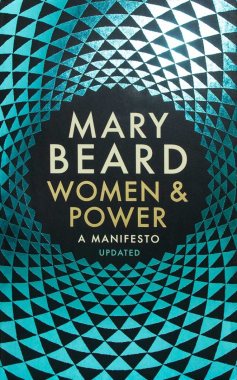 Why are there still so few women in the top jobs? Mary Beard, classics professor at Cambridge, thinks there is a structural problem: “We have no template for what a powerful woman looks like, except that she looks rather like a man,” she says in her book Women and Power, which explores the roots of this predicament in ancient times.
Men in ancient Greece and Rome, she explains, stayed in power simply because power was defined in masculine terms. Everyone knew that to be powerful and to be manly were the same thing. Only men could speak authoritatively in public, not because women were forbidden to open their mouths, but because if they did, nobody would take them seriously.
This silencing of women was an assumption too deep to be questioned. It was supported by appeal to natural laws: the deepness of a man’s voice, for instance, was equated with the profundity of his thought. It was kept in place by stories: the Medusa was a shocking image of a woman who broke the rules and spoke out. And what happened? Perseus beheaded her, and she became a safe object of ridicule.
Where women were allowed to speak in public, it was only in their capacity as women. They might make a declaration about their own martyrdom for instance, or they might speak as wives or mothers to defend the interests of their families. But they might not speak about affairs of state or represent the people as a whole.
The force of the book lies in the way that Beard finds this attitude persisting in our modern world. We still find it hard to hear authority in a woman’s high-pitched voice, which was why Mrs Thatcher apparently took elocution lessons to lower hers. Women who speak up are too easily dismissed as ‘strident’ or ‘whining’, terms that are not usually applied to men. Beard herself has come in for some obscene abuse on Twitter merely, it seems, for the sin of being there at all.
And when women do get into power, they too often find themselves relegated to speaking about ‘women’s issues’ like childcare, equal pay and domestic violence. When they take on public life on its own terms, they are judged much more harshly for their mistakes than men are: witness the shaming of Diane Abbott over a bad interview, compared with the ‘do better next time’ meted out to Boris Johnson for his disregard for facts.
The notion that women simply should not be heard is still around, and sometimes shows itself nakedly. In a popular Internet meme, Hillary Clinton’s grinning face is superimposed on the Medusa’s decapitated head, dripping with blood and gore, while Trump’s magisterial Perseus contemplates her with calm disdain. And other powerful women have had the same treatment.
Women want to be effective, to make a difference in the world, and to be taken seriously. But how are we to do it? All too often the message is that we should behave in a more masculine way. Commenting on the notion that we should banish exclamation marks from our emails (rather like the just not sorry app that is supposed to make us less apologetic) Arwa Mahdawi put it neatly: “Women are socialized to be people-pleasers, sure, but there’s nothing wrong with that. Trying to make other people feel comfortable is a good thing. It should be encouraged!”
How much more satisfying to celebrate female styles of communication and develop our own ideas of what power is – and Mary Beard finds hints of this, too, in the classical tradition. She sketches a few ideas of what it might look like. A key and intriguing phrase is the “decoupling of power from public prestige”. She talks of power as a verb, as something that is expressed in collaboration. She talks of followership, without which leadership would not get very far.
One of the most striking points she makes is about the founders of the Black Lives Matter movement – three women you’ve never heard of, and that’s the point. They made a big difference by getting on with the job, not seeking celebrity status. That’s the sort of power that many of us want, and it is certainly something that needs to be more widely taught and celebrated.
And yet it doesn’t entirely answer the question. We know that women can do good things in the background. The question is, how can we speak out in public and shape national affairs, without throwing our weight about, pretending to know more than we do and fighting our way to the top? We may not have a template for a powerful woman, but maybe together we can create one.
 Finding Our Power