For a few years now I have been a member of a women’s circle, meeting once a month and sharing our experiences of life. This creates bonds of friendship, which is one very good reason for doing it, but it’s much more than that. It’s about creating a different sort of social space, one in which we go beyond our individual concerns and experience a sense of belonging to something bigger. It’s held in place with a clear structure and firm agreements – no giving advice, equal time for everyone, keeping confidences – which allow us to go deeper and say things we wouldn’t risk in ordinary life.
It’s a place to experiment, to allow hidden parts of ourselves to come to light, and I think for all of us it has become an important anchor point in our lives. Not only that, but the way of being that we are learning in the circle is spilling out into the way we live our lives, and it is worth sharing some of that here.
If I had to choose one word to sum up what the circle is about, and there are many – equality, depth, vulnerability, connection – I would choose ‘betweenness’. Or maybe ‘space’. What I have come to learn is that the space between people is as important as the people themselves, and that by paying attention to relationships rather than individuals, we can radically shift our perspective and discover a new way of being in the world. This is the power of the collective, the wisdom that emerges from a group.
That is something which is sorely missing in public life. So much of what passes for debate is a fight between opposing viewpoints which have the quality of marbles in a can, bouncing noisily off each other but never creating anything new. Society become atomized and polarized and we are paralyzed in the face of urgent global questions. If instead we see a matrix of relationships, visualizing perhaps the stretchy filaments of a spider’s web, running from node to node, or the branches of a tree which connect many thousands of leaves facing the sun with thousands more rootlets absorbing water from the soil, we could ask instead how people are connected, and how that connection might be made more harmonious and productive. That way, we express care for the whole.
Betweenness is a concept which Iain MacGilchrist describes very eloquently in his book The Master and his Emissary, which is about the left and right hemispheres of our divided brain. Briefly, it is the right hemisphere that is in touch with reality as a whole, while the left hemisphere – the emissary of the title – uses language and concepts to manipulate the basic impressions it receives. Both are necessary, but all too often the emissary forgets its true function and sets itself up as an authority. You can see that whenever the language of bureaucracy is allowed to prevail over life as it is actually lived.
The right hemisphere works through images, metaphor, bodily sensations and myth, and that is where ‘betweenness’ comes in. Whatever the basis in neuroscience, it is something we can easily recognize in the context of music and art. Just as the individual notes in a symphony, or in birdsong, only have meaning because of the intervals in pitch and time that separate them from other notes – the octave, the semitone, the rests between them and their relative lengths, which give rise to harmony and melody – so the relationships between people, places and things are every bit as real as the entities themselves.
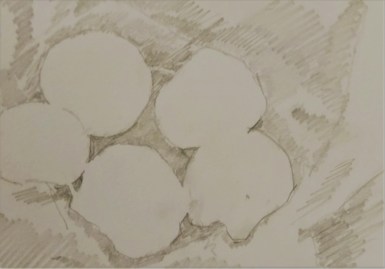 In art, this is expressed as ‘negative space’. One of the exercises in Betty Edwards’ classic book Drawing on the Right Side of the Brain, which is all about outwitting the know-all verbal brain and allowing a fresh response to come through, is to ignore the objects we think we know so well – apples, say – and instead draw the empty space between. We have no experience whatever of the space between apples, which which will different shape in every situation and is in any case curiously non-existent, so we have no formula to fall back on. To draw nothingness is an act of faith, but even beginners can try, and deprived of their usual strategies – think what a picture of an apple looks like and try to reproduce that – they can be surprisingly successful.
Applying this principle of negative space or betweenness to our circle, it means that rather than focusing on ourselves as individuals, we feel into the space between us and sense what’s sometimes called the field of the group. It is so often in the space between people that newness emerges: ideas perhaps, or meaning, or maybe just a warm glow that enables everyone to take a more confident view of life. This betweenness belongs to no-one, and to everyone. It is the reason that someone can make a profound contribution to a conversation simply by listening attentively, without saying anything at all.
In our circle, we are learning a new way of being an individual in a group. This is different for all of us, necessarily, but I think we all experience the paradox that we are freer to be ourselves when we put the integrity of the group first, and that the circle is most powerful when we risk sharing who we really are. Then, we are able to bring that principle into our daily lives, and so we change the world around us.
 Finding Our Power
One thought on “Betweenness and the wisdom of the circle”